From Vegan To Carnivore And Back - What I Learned

Yes, after more than six years of eating a mostly vegan diet, I have experimented with eating mostly meat. Why did I go from one end of the dietary spectrum to the other? Why not just eat a balanced diet?

To be honest, I would like to have some of this carnivore-stamina.

In my past, I had to deal with some digestive issues and cured them through a primarily plant-based diet. But I still had some areas that I was not totally satisfied with. I like to experiment with my diet and see how different foods make me feel. That way, I ate a low-carb vegan diet for a long time now. I am generally doing some form of intermittent fasting too. Among all the vegan foods and supplements that are supposed to improve health, I was attracted and may be blinded by the simplicity of the carnivore diet. Eat meat, drink water.

As it turned out, while working on a free-range cattle farm in Denmark, I had access to a lot of meat, which otherwise would have been thrown away. In this case, I had no moral or environmental issues with eating a lot of meat. Let the meat feast begin and my experiment with the carnivore diet.

I had no issues adopting this diet coming from a low-carb vegan diet. In the beginning, I was still eating a green leafy salad every day. But I reduced it over time. And for a few weeks, I ate almost exclusively meat, still including some coconut and olive oil, but basically no fibre.

I was very surprised to learn that this did not cause any constipation. Stools were of course considerably smaller, but easy to pass. My digestion felt good all the time. Basically, the feeling is similar to water fasting, pretty much empty all the time. Something to get used to, as there is no more being "full" after a meal. Satisfaction still set in though, just through a different mechanism it seems. Instead of the stomach being stretched it is more a signal coming from the brain.

I also did some blood-tests during this time. And this is where the diet became really concerning to me. Before the test, I rode my bike for 15 minutes at a moderate pace. I say that because it might explain the high triglycerides because I haven't eaten anything for more than 12 hours.


I am particularly concerned about the high cholesterol in combination with the CRP value being on the upper end of the spectrum. This means I fall into the high-risk category for heart disease. But according to some of the keto advocates I would be classified as a "lean mass hyper responder". Which means that lean and athletic people tend to experience the highest increase in LDL-cholesterol and total cholesterol. As the body as little other reserves and no glucose available it has to be able to quickly mobilize a lot of fat when exercising. To do that, the body produces a lot of cholesterol.

But I am concerned that this cholesterol is just not good for my arteries in the long run. Based on all the best available evidence, the overwhelming amount of research shows that is saver to have lower cholesterol levels. The whole foods plant-based low-fat diet is the approach with the most scientifically sound data backing it. Taking into account research funding by the industry it is clear that most of the low-carb and ketogenic research might be biased in favour of restricting carbohydrates.

Additionally, during some days on the carnivore diet, I experienced some intense chest pain, increased heart rate and blood pressure. I never had this happen before. Not even on a high-fat vegan diet.

Here is what I am going to do:

I have ended my carnivore diet around a week ago and started a water-only fast. I want to extend the fast to 14 days. Coming from a ketogenic diet is a good way to start a water fast as the body does not have to switch fuels from carbohydrates to fats. The transition period was easy.
After that, I will go back to the diet which I think is the healthiest in the long run: a whole-foods, plant-based, low-fat diet. Will I eat completely vegan? Probably not. On certain occasions, where the best quality meat is available, maybe a handful of times a year, I will eat meat. But that will still make my diet 99,9% plant-based.

This is the diet that has healed my digestive issues and has kept me feeling very good for the majority of my vegan period. But my experimentation with the low-carb approach was definitely interesting and has me taught to understand people eating carnivore. There are definitely benefits to this way of eating. But overall and for the majority of people, the whole-foods plant-based approach is by far the better option. And for the environment, it is anyways because even totally free-range raised meat requires much more land and resources than sustainably farmed plants. Not to mention that most people can't or won't afford the cost of this meat and instead by lots of factory-raised meat products.

Decision Fatique - Not Another Piece Of Information

You came across this blog looking for answers, right?
You opened up your browser because you had some kind of question?
Your curiosity led you to search for experiences of others on the web, experiences you can relate to and learn from.
You want to reach a desired outcome by implementing what worked for others.
This is probably not the first time you used this method. This might have become your new normal.
You have a question or a problem? It surely is already out there; somebody has already lived through it and has come up with a solution. So, clearly, the most efficient way is to look it up.

Information overload? How confusion can help us see more clearly.


This is, in fact, not only you whom I describe, but myself.
I grew up with the internet and with Google. When I was younger, I still had to use a computer every time I wanted to look something up and do it at home, but it was not much different from asking Google through a smartphone.


What is this new environment doing to the way we think, and especially to the way we come up with solutions? How is our creativity influenced, and has it changed our decision process?
How can we know what is right for us? Among all the different ways people live their lives and have made it visible through social media?
When do we reach the point where we can say we have read enough to make a decision?


How do we discriminate the honest from the dishonest?
Who is stuck in his story because he has created a product around the information he provides?
What resources are worth taking into account?
Can we judge the value of the information by how we feel about the person who is providing it?


You probably think that all of these questions make your decision more difficult instead of easier.
You are right and wrong at the same time. Because the resources to deal with any deep and meaningful problem in your life lie mostly within yourself. So you are right in the sense that the search for deep and meaningful answer from others are never going to fully apply to your own situation and is therefore highly confusing and very complex. And you are wrong because you can rely on your own insights to be fully applicable to your current situation.


I guess you have noticed now what I did here. Instead of giving you another answer or another personal life story you can compare your own to, I leave you with open questions. I hope that you embrace uncertainty and let yourself be guided again by your own creativity. I hope that, the next time you want to look for an answer on Google, you pause for a second and remind yourself to tap into the intuition and inner intelligence that lie already within you.
That is all we are doing here in all the blogs and videos anyway, we inspire each other and help each other learn faster and to avoid mistakes. But in the end, everyone has to craft their own unique path with it's own unique challenges and solutions. I guess that's why it's called Life.


Insights On How To Act And Achieve Your Goals

Have you ever wondered why some people seem to have an easier time to challenge themselves than others? Why can some people stick to their exercise routine and others not? Why do some people take risks and work on actualizing a vision they have in mind and others stay stuck where they are?

Maybe wakeboarding is your goal

During meditation and contemplation I have gained some insights into how the mind works in this regard. At least how it is in my mind, and maybe you will find some of these to be true for yourself. 


Envision these following steps with me here to arrive at these insights for yourself.


  1. Feel what you basic mood is right in this moment.
    1. What is on your mind when you try to be as neutral as possible?
    2. Are you generally in a positive mood or a negative one?
    3. Is something bothering you right now?
    4. Get a general picture of your current emotional situation without reference to one particular situation or object.
  2. This is your baseline happiness. Research shows, no matter what happens in your life, you tend to always come back to this baseline level of happiness.
  3. Now think about some project, some goal, something you would like to do, but are not currently doing because something holds you back.
  4. Now that you have this vision in your mind, notice how the baseline mood which you identified before has blended in with this vision. 
    1. They are not separate
    2. It would take an enormous amount of imagination to actually elicit the feelings that come with that action you envision
  5. What can we take home from this observation? 
    1. It is not possible to judge any of our visions by how we feel when we think of it.

Example:
You have the goal of doing exercise first thing in the morning. You want to go for a run. Now you woke up and you feel tired and not yet energized. Exercising seems like an impossibility. You tell yourself that exercising now will feel way to hard and difficult. How do you come to this conclusion? By observing your current mood. Notice that thinking about exercising didn't give you the same mood as actually exercising does. If you actually end up going out and start exercising, you will feel the outcome of that vision after maybe 10 minutes. 

We can see from this simple example that our visions happen in a completely different state of mind than the actual lived reality of these visions. 

Conclusion:

I think that people who have an easier time acting on their goals and actualizing their visions, have a greater ability to imagine and evoke the feelings they associate with their vision. In this way, when they think about their goal, they actually get a little boost in how good they feel and that motivates them to achieve it as well. Whereas someone who has little imagination will not have an emotional response to his visions, and that leaves him with no reason to achieve his goals. 

You can take this insight and test it for yourself. Try to infuse in your vision or goals as much emotional power as possible. Thinking about it rationally from your current level of happiness won't really motivate you. But actually connecting to the emotional level of your goals will give you a boost.

On the other end of the spectrum, I think it is important to mention that this can be taken too far. I have found that overly indulging in positive emotions associated with a certain goal can be so pleasurable that it seems unnecessary to put some actual effort in its realization. Just something to keep in mind.

Vegan Keto: Most Important Problems You Have to Avoid

Polyunsaturated Fatty Acids:

The biggest problem I observed with the vegan ketogenic diet is the distribution of fatty acids. If not taken care of, the omega-6 content of the vegan keto diet can get excessively high. And this becomes a problem, because omega-6 fatty acids tend to become inflammatory if eaten in excess.

Walnuts are healthy only in limited quantities on vegan keto.

To reap the anti inflammatory benefits of the ketogenic diet, it is important to keep a good ratio of omega-3 to omega-6. The ratio should ideally be kept between 1:1 and 1:4 of omega-3 to omega-6.

From my personal experience I have found that it is also important to keep the total amount of omega-6 as low as possible. It does not help to try to compensate a high intake of omega-6 with a high intake of omega-3. Those fatty acids are essential, but only in small amounts. Any excess exceeds the bodys capacity to handle them properly.

What amount is too high? I have found intakes of omega-6 below 15gr per day to be okay.

This means the following nuts and seeds need to be resitricted: walnuts, sesame seeds, sunflower seeds and pumpkin seeds. But also almonds and peanuts to a lesser degree. This makes the vegan ketogenic diet even more restrictive to some people.

The focus should be put on coconuts, hazelnuts, macadamia nuts, pistachios, chia seeds, hemp seeds, avocados, olive oil and high oleic varieties of peanuts and sunflower seeds. Flax seeds should be added to the daily diet in amounts of about 20-30gr per day.

I have recently found a source of high oleic peanuts and added them to my diet. They have made this diet a lot more sustainable. I love peanuts and being able to eat them daily made them the best discovery for this diet.


Roasted Nuts and Seeds:

The second biggest trap you could fall into are roasted nuts and seeds. Especially store bought roasted nuts, where you can't control the temperature. This might be one of the reasons why you don't feel good on a plant-based keto diet. Roasted nuts and seeds are often fried in cheap omega-6-rich vegetable oils. These should be avoided at all cost, if your aim is optimal health and longevity. 

The roasting process oxidizes the unsaturated fatty acids and makes them act as free radicals in the body. The vitamin E content of roasted nuts is greatly reduced.

The same goes for nut and seed butters. Often times they are roasted and then ground into a paste at high processing temperatures.

Solution: Buy raw nuts or seeds and roast them yourself so you can control temperature and time. I recommend you roast them for 20min at 120°C, just to the point where they are fully cooked but have not yet turned brown.
For nut-butters, I  have found brands that use no or low roasting temperatures and grind them carefully. You need to try a few until you find the best ones. 


I hope these tips will help you reap the benefits of a plant-based low carb or ketogenic diet, loose weight, enjoy your food, feel satisfied and mentally sharp, all without having to eat tons of animal products that harm our environment and our health. 

Optimizing Keto (Complete Guide)

With the ketogenic diet becoming so popular right now, I feel that it is very necessary to provide a plant based view on the diet. I myself am eating a plant based (mainly whole foods) ketogenic diet. And I feel that this approach combines two very powerful concepts and avoids the negative outcomes from high animal product consumption.

By volume, my diet is mostly leafy vegetables...

When you read reports on the internet from people, who switch to a ketogenic diet high in animal products, often times they still report great increases in their health and well-being. Many of them loose weight and build muscle. So it is clear that the diet provides some mechanism by which the body is better able to generate energy without too much harmful byproducts, as is the case when large amounts of processed carbohydrates are mixed with fats and proteins from animals. This western diet is clearly the worst of all dietary choices and eliminating one bad food group (processed carbohydrates) is clearly a step in the right direction.

...by calories, my diet is mostly nuts,
especially coconut.
When carbohydrates and fats are eaten together in an hypercaloric environment, they prevent each other from being metabolized efficiently by the body. From my own experience I can say that both approaches work (high-carb, low-fat as well as high-fat, low-carb). But they work because of different mechanisms and these macro-nutrient-ratios do not tell the whole story. In both cases I think it is important to stick with mostly whole foods. A low-fat diet doesn't work well if the diet is composed of refined grains or even whole grain flour products. Carbohydrates must predominantly come from slow digesting, fiber-rich sources, such as vegetables, fruits and beans. (Although some high calorie fruits like bananas can be too calorically dense and relatively devoid of nutrients)


Why you should not choose a meat-based approach to keto:

I am not saying you can never have meat or animal products if you want to be in optimal health. They can surely be eaten in small amounts without having negative health consequences. Before we dive into the all positive aspects of plants on a ketogenic diet, here follows a list of why you want to limit animal products to 1-2 servings a week.


  1. On a keto diet you consume high amounts of fat. Choosing animal sources of fat is not a good idea because environmental toxins are mainly stored in the fat tissue of animals. Read more
  2. Regular consumption of animal protein raises IGF-1 to excess levels, promoting tumor growth. Read more
  3. Animal protein consumption raises cortisol levels and lowers testosterone. I have experienced this myself after occasionally eating meat in the evening and every time having trouble sleeping afterwards. Read more
  4. Animal protein accelerates the aging process through increased levels of methionine, cysteine and leucine. Read more
  5. Meat can negatively influence the composition of the gut-microbiome, leading to the production of carcinogens in the large intestine. Read more

This list is unlikely to be complete. I am sure, science will discover more aspects of nutrition in the future.
If health reasons are not convincing you to at least limit animal product consumption, environmental reasons might still be important to you. Drastically increases ones meat consumption, as many ketogenic dieters do, is environmentally absolutely unsustainable if more people would follow this diet. There just not enough resources to feed so many animals and not enough fields to take up all of their waste. But I am repeating myself.


Benefits of the whole-foods plant-based approach to keto:

What foods are we talking about here?

Hazelnuts, Coconut, Almonds, Flax Seeds, Sunflower Seeds, Chia Seeds, Pumpkin Seeds, Cacao Beans, Avocados, Sesame Seeds, Peanuts, Walnuts, Macadamia Nuts, Soybeans, Cashews, Olives.
These are the foods I eat the most of, from a caloric perspective. And also in roughly that order. 

All of these foods come with a multitude of health benefits, They all contain fiber, minerals, vitamins, polyphenols, antioxidants and protein. Carbohydrates are present in most of them as well, but only in very small amounts and they are very low glycemic. This leads to a state in which the body produces almost no insulin to process these foods. They release their fat-content slowly over the course of several hours and do not spike blood-sugar or blood-triglycerides. Consumed in their raw form and with an eye on the overall omega-3 to omega-6 ratio, they provide steady energy from unoxidized, heart-healthy fatty acids. 

Important note on roasted nuts:

To avoid negative health consequences it is very important not to consume roasted nuts or seeds, as they contain high levels of advanced glycation end-products (AGEs) and oxidized fatty acids. Which both act like free radicals in the body and can damage tissues. Keeping an eye on this is important and make the difference between success and failure on this diet. Most store bought nuts are either fried in vegetable oils or roasted at too high temperatures, especially peanuts and all flavored nuts. When you see that a nut is brown on the inside, you can be sure it is oxidized and full of AGEs. Avoid those. If you prefer roasted, than buy them raw and lightly roast them yourself with an eye on temperature and time (20min at 100°C should be okay). 


Coconut and saturated fat on the ketogenic diet:


Shredded coconut is a major part of my ketogenic diet. I eat it at almost every meal. If you have read about the ketogenic diet and the role of LDL and HDL cholesterol, you will know that high levels of both do not indicate a harmful metabolic state. They are proteins that carry fat in the blood-stream and deliver to the cells. So a high-fat diet will naturally increase the presence of those proteins.
Why is then LDL cholesterol considered a risk-factor for heart disease by most doctors? This is complicated topic and it probably takes a long time until we know all the details of how the body works. But new meta-analysis like this one are coming out and are going to change our view on saturated fat intake and cholesterol levels.


Good for your environmental conscience:

By eating plants as a source of your calories your diet will also have a major positive impact on the environment. Moving away from growing grains and other seasonal crops to planting trees for our foods sources, such as nuts, will be good for the climate by storing CO2, provide a habitat for a variety of species and causing less soil disturbance, among many other positive changes.


By volume, your diet will consist of mostly leafy vegetables, if you want to optimize your health. All vegetables that are lowest in carb are also very nutrient dense on a per calorie basis. By combining large volumes of those vegetables with the high caloric density of nuts, you can optimize your intake of micro-nutrients. The problem on a high-carb diet is that the relatively nutrient-poor grains already take up a lot of stomach-volume, so that it becomes uncomfortable to eat the amounts of vegetables required for optimal health. But the combination of vegetables and nuts is perfect in my opinion. Protein and carbs never digested well for me, whereas fats and protein digest perfectly together and also increase the nutrient absorption from the vegetables.
I strive to eat at least 500gr of raw vegetables and 500gr of cooked vegetables a day.

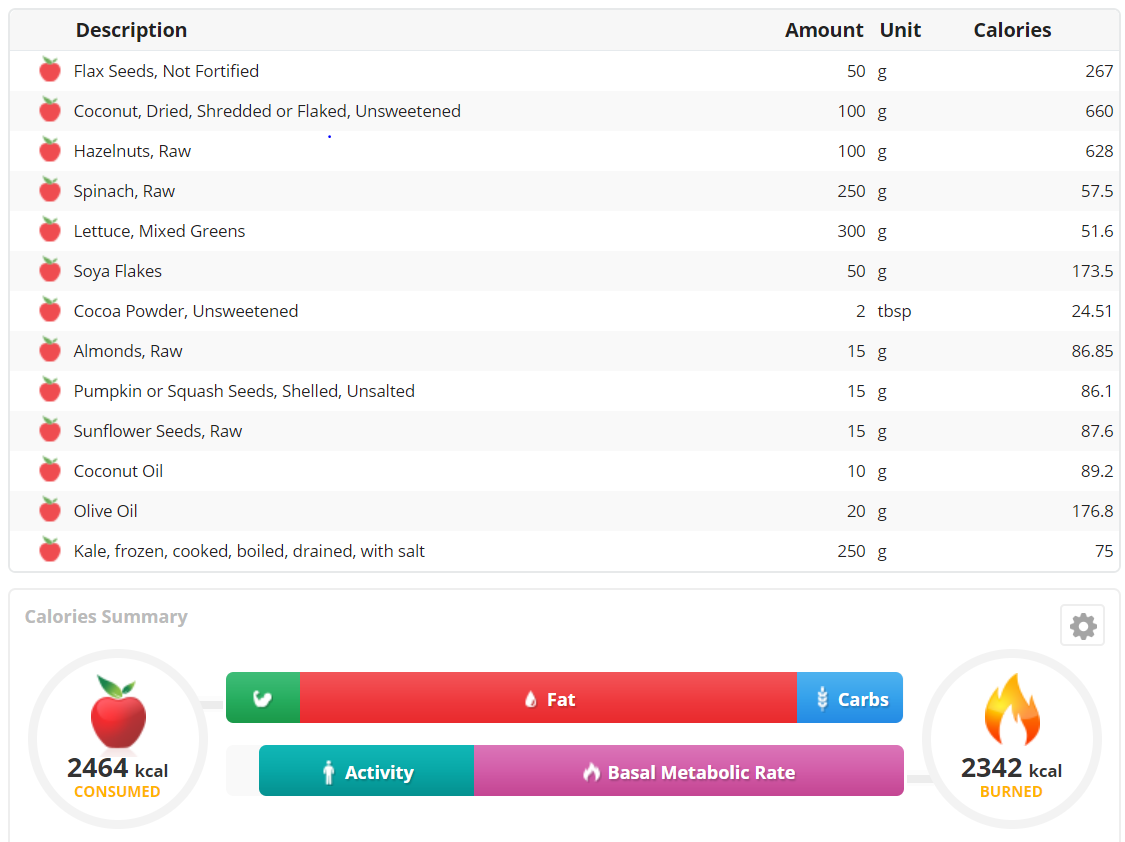
Here is what a ketogenic day of eating might look like for me in cronometer:


Even though some people consider 40gr net-carbs to be on the high-end for a ketogenic diet, I think it is not going to reduce utilization of ketones at all. All those 40gr of carbs are bound to fibers and are released very slowly so that they are immediately picked up by the cells of the body without the need for any significant amount of insulin. All the fiber is also going to be turned into ketones by the bacteria in the large intestine, further contributing to ketone-levels.

Most people apply the ketogenic diet to achieve a caloric deficit without having to experience too much hunger. This is one major advantage of this diet. But some people (like me) are actually on this diet and eat a caloric surplus to gain muscle. The benefits we are after are the anti-inlammatory effects of the ketones and to avoid the negative side effects of excess carbohydrate consumption. What follows are therefore my explanations of the combination of exercise and keto.


Exercise on keto:

Keto in a caloric surplus

In order to build muscle and gain weight, it is necessary to eat a caloric surplus if you are already lean. The major benefit of doing this on keto is that the body can very efficiently utilize the excess calories from fat, compared to carbohydrates. Storing excess carbohydrates is a messy process. The liver has to convert them to fat and this spikes triglycerides, which is bad on a high-carb diet. The steady energy-supply from fats on the other hand provides growing muscle with a constant supply. And most importantly, the anti-inflammatory nature of the diet (or rather of the ketones) counteracts most of the negative effects of over-feeding. 


Working out on keto:

Most people would describe the process of building muscle as slower, when compared to a high-carb diet. But I would argue that you also limit the fat gain (if you keep an eye on overall calories), while building muscle based on strength rather than on the "pump". Working out on keto is different. It does not allow for huge volume in a single session, for a single muscle. The "bro-science one body-part per day-split" does not work well with keto. After the initial adaptation I have found that I am able to train very heavy (1-3 reps) without any performance loss, while the medium rep ranges from 5-10 were a little compromised. On the other end of the spectrum, 20+ reps were possible as well. 
And I had to keep the overall number of sets per muscle lower. While I have never been a fan of the above mentioned split training, where you train a muscle once a week with high volume, I had to switch to even lower volume to keep the intensity high at each set. 

That means, the best approach for any natural lifter (especially on keto) is to train every muscle as frequently as possible with heavy weights (1-5 reps) and 3-4 sets per muscle. For me, this has turned into High-Frequency-Training, where I train my whole body 5-6days a week, with 7-9 exercises in each workout. Squatting, pressing and pulling every-day. Never to failure and always choosing the weights according to how the warm-up sets feel on that day. I think this is the optimal approach for weight-training on keto. It gives the muscle enough time to replenish glycogen store before the next session as it does not deplete them significantly.

Cardio can be done on the ketogenic diet (after the initial adaptation) without any performance loss. But it might take a couple of month before your level of endurance reaches higher than before. What I particularly like about aerobic exercise on keto is the fact that I need to breathe less. Fat burning requires less oxygen and when you are working hard this can be a tremendous relieve, making the exercise feel less demanding.


Infinite Potential for Exploration

The inherently limitless nature of reality means that there never is a lack of something. Experience can venture out in every dimension without boundary. The slice of experience, which you call "your life" is just one of an infinite number of possible stories of experience.

Whenever you start to explore the nature of reality, you will encounter a limitless ocean of interconnections, explanations and experiences... until you discover the flipside of the coin. This is the moment you discover that nothing ever really happened. That all of this, what you call reality, is actually encompassed by nothingness. That there is no outside, and therefore no inside. The absolute mindfuck. That there is nothing, but that it is alive and moving. Every piece in existence finds it's opposite pole and annihilates itself.

To experience what is described here is only possible with a strong dose of psychedelics. At least that is my experience so far. No amount of meditation or self-inquiry has yet provided me with the same depth of insight that I got out of my psychedelic encounters. Be careful and educate yourself before embarking on a psychedelic journey. It can be challenging and at times overwhelming experience. Always start with a low dose and slowly increase over time.

Simplicity of Truth

A statement can be defined as true only within the limits of a certain system. There can be an infinite number of systems. Which in themselves can produce an infinite number of true statements. For example within mathematics.

Each system is a subsystem (or rather a part) of reality. Therefore no system is able to make a true statement about the nature of reality. The infinite nature of reality always escapes any set number of rules.

Further, each statement about reality is made from a certain, finite point of view within infinite reality. The search for an ultimately true statement always reveals it's own tool or mechanism by which it tries to define reality as inadequate and illusory.

Truth is undefinable. No statement can ultimately be made about it. That's why it is so difficult to talk about enlightenment.

The Power of Yes: An Approach to Mindfulness

All Day Awareness or mindfulness in daily activity is the extension of formal meditation practice into your daily life. Over time I have found this practice to be extremely powerful in transforming my outlook on life, my happiness, my capacity to witness emotions, my ability to concentrate, my contentment in difficult situations, my ability to reason and in general my feeling of well-being.

Embracing all of (your) reality.
But there is an important aspect to this practice that I want to talk about in this article. And that is how to approach this state of radical openness of whatever arises in the present moment. 

When you practice awareness of the senses and your thoughts, automatically another function of your thoughts will arise. Your thoughts (or your ego) will try to hijack your higher state of awareness. You will start to hear comments about your mindful observer mode. Thoughts will try to take over this new position of being aware of the rest of your experience. This happens in really sneaky ways. If you are mindful you will hear a lot of commentary when you witness your current experience. Comments about other thoughts, about emotions, about sounds, sights and feelings. And those commentary thoughts will claim to be the observer, it is easy to identify with those commentary thoughts. Include those commentary thoughts also in your mindful observation. Treat them as any other sensations. This is difficult step and requires and additional level of mindfulness.

And the main reason for this article is the attitude with which we approach mindfulness. It is like the color of the filter through which we observe our moment to moment experience. As soon as an  experience has some special meaning to you, your mind is going to judge and comment on it. And with applying the right filter we can learn and embrace more of what we experience. And the filter I recommend is a Yes to all of your experience. 

What does this mean? Welcome everything. Be of no resistance to what appears in your consciousness. Be a superconductor. Let everything flow through you. Open the flood-gates as wide as possible. 

A Yes feels widening and freeing, whereas a No feels constricting and limiting. Allow yourself to feel also the emotions that are commonly labeled as bad. You begin to embrace the full spectrum of your humanness. Experience will become richer. You will learn that challenging emotions only become problematic when you try to resist them. We cannot change what actually exists. We can only observe and learn, so that we may create a different future. 
When you allow all emotions to flow through you, they quickly resolve and you can observe them with an open and genuine interest, like a scientist who wants to learn more about how his inner mind works. 

Learning by observation greatly helped me to understand situations and my resulting judgments and desires. Often times the root causes will be revealed, but without a rational explanation. Instead you will know in every moment the underlying emotions that triggered your current state of mind. This is a kind of self-knowledge that only observation and no rational talk-psychotherapy can teach. 

You always have the possibility to control the level of openness though. Should the emotions become too overwhelming ,for example when you are dealing with some serious trauma, you can still put the lid on. But as long as you remain firmly rooted in the presence of wide open awareness, you will feel that none of the content that appears can actually hurt you. Your identification with any content in your awareness will greatly decrease. You realize there is no difference between you and consciousness. There never was any separation. You are consciousness. And all that ever happens IS. Changing, fleeting, ultimately groundless and substance-less, self-aware appearances. On a deeper level of reality consciousness is not separated from that which appears. It is all just ISness as different forms and in different dimensions (as the sensory experiences and thoughts). 


Summary of the benefits to approaching your experience with a Yes instead of a No:
  • negative emotions don't last as long the less we resist them
  • as an open observer we are not longer fully controlled by our emotions 
  • we gain the ability to do the best in more and more situations
  • from observation we can learn where our current motivations are grounded in
  • our experience becomes richer and we act more authentically
  • we open ourselves up to have realizations about deeper aspects of reality
  • we will feel happier with our moment to moment experience
  • fears and worries have less of grip over us
  • getting lost in mental scenarios about the future or past is less likely

The Nature of Memories

How our minds construct memories

When I think about my past, I unconsciously assume that what I have in my mind is actually a pretty good representation of the events that happened. You have probably already learned that this is not the case. Our brains are not truth machines. But rather survival-machines. Energy was highly important in our evolutionary past and conservation of energy an important adaptation. This resulted in a sorting mechanism for your memories that is geared towards securing your survival, so that you can pass on your genes and keep your offspring alive long enough so they can do the same.

Old Train
The further we go back in time the more vague our memories are

This situation is fundamentally counterproductive if we try to remember the past as it actually was. Emotions and sensory input blends into a vague feeling of who and what it was that we encountered in that situation. Inner and outer world have no clear distinction. And to make it worth, every time we remember or tell our friends about a past event, our memory actually changes. What we remembered in the past of an event becomes the event. This is where it get's interesting.

Over time we construct a story of who we think were in the past. The further we go back in time, the more we become the stories which we have told ourselves and others about ourselves. A few of our memories stand out more than others, even though they only represent a tiny slice of our past. We need to realize here that what we think we are, is mostly a self constructed story. Our egos are these self-constructed, biased stories we believe was actually our past. The ego is larger than this, but this is a fundamental part of it.

How this understanding leads to deeper insight into ourselves

The first step is the realization of this. If we understand that the past is mainly a self-created story in our minds, which is geared towards survival and not a mechanism to accurately represent truth, it allows us a greater degree of freedom. In not taking the past so seriously, we gain another degree of freedom. It opens us up to the path of truth-realization, in the sense that we can now begin to realize what we truly are. A story, among an infinite number of stories, playing itself out as it has to. Because otherwise, absolute infinity would miss exactly your current experience. We gain the freedom to realize that in all this, there is no consciousness which is separate from appearance. That appearance is inherently self-conscious, and that what we are is not what we thought we were.

We become free from the limitations of the ego through the realization that the self-identification is no more than a story. And this story is playing itself out without a separate I. But with strong attachments in the dimension of thought and with a particular strong emphasis on thoughts about a largely illusory past, which it calls "I".

Further down this path, it opens us up to the deepest insight into our human psyche. Which is the insight that we are not that story and that what we are is not separate from the ground of all being. The stateless state that already existed before our universe with all it's inherent qualities and dimensions of time and space was born. That state where all of existence is fundamentally one and not yet manifested as the seemingly separated world which we perceive now.

The practical methods

There are people out there, many of them following the neo-advaitans, who believe that the logical understanding of this is already enough and all is already realized. In my experience this is not true. The manual is not good enough, we also got to practice. And most enlightened beings have worked hard to reach a high level of truth realization.

If you want to improve your capability to deal with your every day life, than I recommend you install a daily meditation practice. Meditate for about 30-60 minutes every day and make it a habit. Largely focus on developing concentration. Sit still and allow yourself to rest in simple being and focus on the breath.

If you are interested in seeing through the illusions of the ego for yourself you got to do self-inquiry and probably psychedelics.


If anything, I would wish that this article gave you some sense of freedom. I hope you were able to realize that you are in the position to choose how much of yourself you want to be defined by this story of your past. Maybe it can even set you free to discover those realization and insights for yourself.